
In this article
- MQTT works best for IoT apps that need lightweight, efficient communication for devices with limited resources
- AMQP provides strong enterprise messaging with advanced routing, transaction support, and guaranteed message delivery
- MQTT uses a simple publish-subscribe pattern while AMQP supports multiple messaging patterns including point-to-point and publish-subscribe
- Protocol choice depends on specific use cases: MQTT for IoT sensor networks, AMQP for enterprise systems requiring complex routing
- Both protocols offer scalability but through different approaches - MQTT through simplicity, AMQP through feature richness
- Understanding the differences between MQTT and AMQP helps organizations choose the right messaging protocol for their infrastructure
- MQTT Protocol Overview
- AMQP Protocol Overview
- Key Differences Between MQTT and AMQP
- IoT Use Cases and Protocol Selection
- Enterprise Messaging Considerations
- Scalability and Reliability Comparison
- Implementation and Deployment Factors
MQTT Protocol Overview
MQTT (Message Queuing Telemetry Transport) emerged as the top messaging protocol for IoT applications. It has minimal overhead and efficient bandwidth usage. The MQTT protocol operates on a publish-subscribe model. MQTT clients connect to a central MQTT broker that handles message distribution to subscribers based on topic hierarchies. The protocol's lightweight nature makes it ideal for IoT devices with limited processing power and memory. MQTT messages carry small headers, typically just 2 bytes for the fixed header. This makes it extremely efficient for transmitting sensor data across limited networks. This efficiency explains why developers choose to use MQTT for IoT deployments. These range from smart home sensors to industrial monitoring systems.MQTT Quality of Service Levels
MQTT implements three quality of service levels. These balance reliability with performance requirements. QoS 0 provides fire-and-forget delivery without acknowledgments. This is perfect for frequent sensor readings where occasional data loss is acceptable. QoS 1 guarantees at-least-once delivery through acknowledgment mechanisms. QoS 2 ensures exactly-once delivery using a four-step handshake process. The MQTT broker manages these QoS levels automatically. It maintains message queues and handles retransmissions when network issues occur. This automatic queue management simplifies client implementation. It also provides configurable reliability guarantees based on application requirements.MQTT Connection Management
MQTT connections utilize persistent TCP sessions with built-in keepalive mechanisms. This maintains connectivity across unreliable networks. The protocol includes last will and testament functionality. This allows devices to specify messages that the broker should publish if the connection drops unexpectedly. This feature proves essential for IoT applications requiring immediate notification of device disconnections. MQTT clients can subscribe to multiple topics using wildcards. This enables flexible message routing without complex configuration. The broker handles all message routing internally. This eliminates the need for clients to understand network topology or implement custom routing logic.AMQP Protocol Overview
The Advanced Message Queuing Protocol (AMQP) provides enterprise-grade messaging capabilities. It offers sophisticated routing, transaction support, and guaranteed message delivery. Unlike MQTT's simple broker model, the AMQP protocol implements a complex architecture. It uses exchanges, queues, and bindings that enable flexible message routing patterns. AMQP supports multiple messaging patterns beyond publish-subscribe. These include point-to-point queuing, request-response, and broadcast messaging. This versatility makes AMQP suitable for enterprise messaging scenarios. These require complex message routing, transaction management, and integration with existing business systems.AMQP Message Routing Architecture
AMQP routes messages through exchanges that act as message routing entities. Messages are routed from producers to exchanges. Then from exchanges to queues based on routing keys and binding configurations. This sophisticated routing mechanism enables complex message distribution patterns. These would require significant custom development in simpler protocols. The protocol supports different exchange types. These include direct, topic, fanout, and headers exchanges. Each exchange type implements specific routing algorithms. This allows system architects to design messaging flows that match business requirements precisely. AMQP support for these routing patterns makes it particularly valuable for enterprise messaging. Different services need various message distribution strategies.AMQP Transaction and Reliability Features
AMQP provides transaction messaging capabilities that ensure message delivery consistency across distributed systems. The protocol implements publisher confirms, consumer acknowledgments, and transaction rollback mechanisms. These guarantee message processing reliability even during system failures. Message queues in AMQP can be configured as durable. They survive broker restarts and maintain message persistence. This reliability extends to message routing. AMQP ensures messages reach their intended destinations through mandatory publishing and alternate exchange mechanisms. These features make AMQP essential for enterprise messaging systems where message loss could impact business operations.Key Differences Between MQTT and AMQP

Protocol Architecture Comparison
AMQP implements a more complex architecture with separate entities for message routing. The AMQP protocol uses exchanges to receive messages from publishers. It then routes messages to queues based on configurable binding rules. Consumers then retrieve messages from specific queues. This enables precise control over message distribution. This architectural difference means MQTT provides simpler deployment and configuration. AMQP offers greater flexibility in message routing patterns. The two protocols serve different needs. MQTT for straightforward publish-subscribe scenarios. AMQP for complex enterprise messaging requiring sophisticated routing logic.Message Format and Overhead
MQTT messages use binary format with minimal headers. These are typically 2-5 bytes depending on variable header content. This efficiency makes MQTT suitable for bandwidth-limited networks and battery-powered devices. The protocol doesn't specify message payload format. This allows applications to use any data serialization method. AMQP messages carry more metadata. This includes routing keys, headers, and delivery properties. While this increases message size, it enables rich message routing and processing capabilities. AMQP message format supports structured headers and properties. These facilitate complex enterprise messaging scenarios requiring message transformation and routing decisions.Performance and Resource Usage
The differences between MQTT and AMQP extend to performance characteristics and resource requirements. MQTT's lightweight design enables higher message throughput with lower memory and CPU usage. A single MQTT broker can handle thousands of concurrent connections from IoT devices while maintaining low latency. AMQP's feature richness comes with higher resource requirements. Message routing through exchanges and queue management requires more CPU and memory resources. However, AMQP's sophisticated features often eliminate the need for custom application logic. This potentially reduces overall system complexity in enterprise scenarios.IoT Use Cases and Protocol Selection
IoT applications represent the primary domain where MQTT vs protocol selection becomes critical. The internet of things covers diverse use cases. These range from simple sensor networks to complex industrial automation systems. Each IoT use case presents unique requirements for message delivery, reliability, and resource constraints. Smart home applications typically favor MQTT due to device power constraints and simple communication patterns. Temperature sensors, door locks, and lighting controls benefit from MQTT's low power consumption and efficient message transmission. The publish-subscribe pattern matches perfectly with home automation scenarios. Multiple devices need status updates from sensors and controllers.Industrial IoT Protocol Requirements
Industrial IoT deployments often require more sophisticated messaging capabilities than consumer applications. Manufacturing systems need guaranteed message delivery, transaction support, and integration with enterprise systems. These requirements can push IoT protocol selection toward AMQP when reliability outweighs power efficiency concerns. However, many industrial IoT use cases still favor MQTT when deploying large numbers of sensors across factory floors. The protocol's efficiency allows single gateways to aggregate data from hundreds of sensors. They then forward information to enterprise systems using more robust protocols like AMQP for critical business integration.IoT Device Constraints and Protocol Impact
IoT devices face unique constraints that significantly impact protocol selection. Battery-powered sensors require protocols that minimize radio transmission time and frequency. MQTT's compact message format and configurable QoS levels allow devices to balance power consumption with reliability requirements. Memory-limited microcontrollers favor MQTT's simple implementation requirements. MQTT clients require minimal code and memory footprint. This enables deployment on 8-bit microcontrollers with limited RAM. AMQP's complexity makes it unsuitable for the most resource-limited IoT devices. Though it works well for IoT gateways and edge computing systems.Enterprise Messaging Considerations
Enterprise messaging environments present different requirements than IoT deployments. They often favor AMQP's sophisticated features over MQTT's simplicity. Enterprise messaging systems integrate multiple business applications. They require transaction support and demand guaranteed message delivery across complex network topologies. AMQP and MQTT support different enterprise integration patterns. AMQP allows complex message routing that can replace expensive enterprise service bus solutions. Messages can be routed based on content, headers, and business rules without requiring custom application logic. This capability proves valuable for enterprise messaging scenarios requiring dynamic message distribution.Enterprise Reliability and Compliance
Enterprise systems require message delivery guarantees that impact protocol choice decisions. AMQP provides transaction messaging capabilities essential for financial systems, order processing, and other business-critical applications. Message loss could cause significant financial impact in these systems. The reliability differences between the two protocols become evident in enterprise disaster recovery scenarios. AMQP's durable queues and persistent message storage ensure business continuity during system failures. MQTT's lighter reliability model works for many enterprise applications. But it may not meet strict compliance requirements in regulated industries.Integration with Existing Systems
Existing enterprise infrastructure influences protocol selection decisions. Organizations with established message queue systems often choose AMQP for consistency with existing messaging patterns. The AMQP protocol integrates naturally with enterprise messaging systems, database transaction managers, and business process management tools. MQTT's simplicity can actually complicate enterprise integration when business logic requires complex message routing or transformation. Organizations may implement hybrid approaches. They use MQTT for IoT data collection and AMQP for enterprise message processing. This bridges the two protocols through gateway applications.Scalability and Reliability Comparison
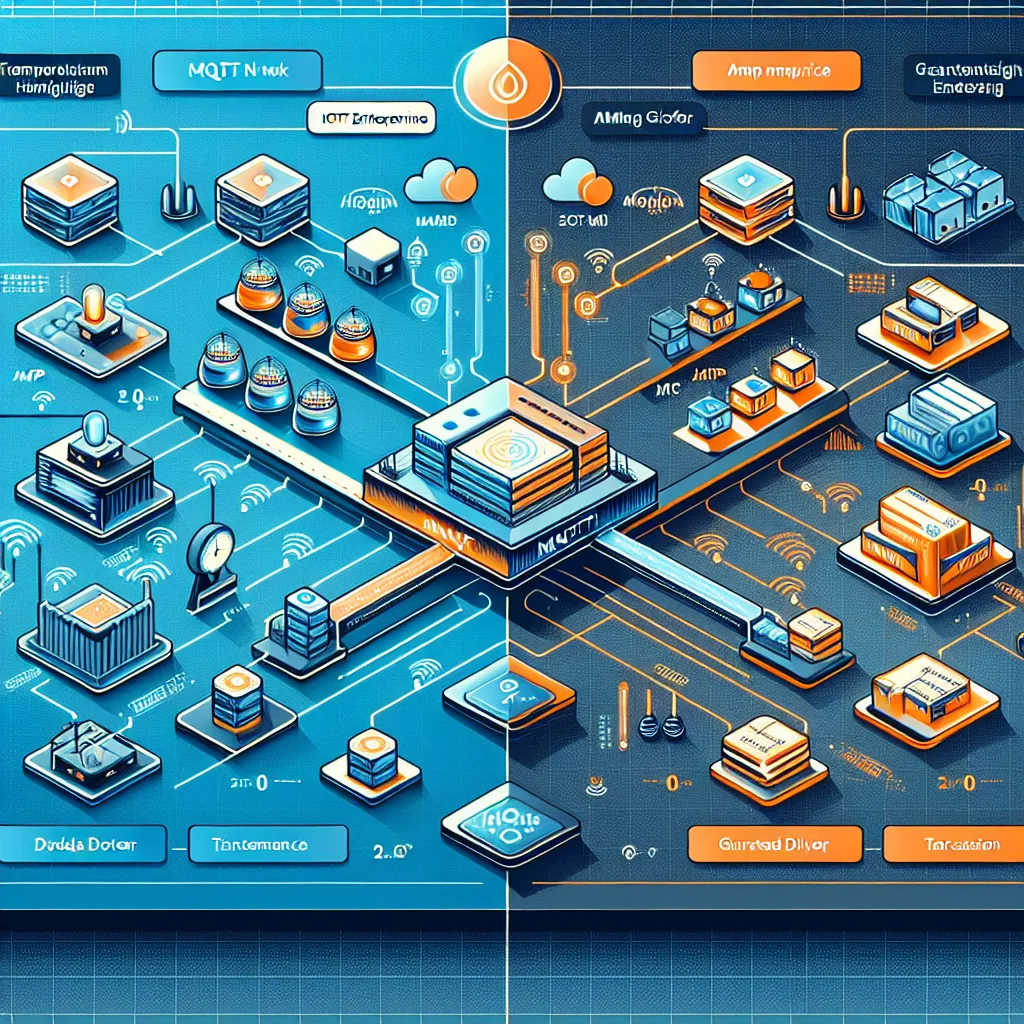
MQTT Scaling Patterns
MQTT scalability relies on broker efficiency and simple message routing. Publishers and subscriber connections distribute across multiple broker instances. Message routing is handled through broker federation or clustering. This approach works well for IoT scenarios where message volume scales with device count. The MQTT protocol's lightweight nature enables scaling through geographic distribution. Edge MQTT brokers can handle local device connections while forwarding critical messages to central systems. This hierarchical scaling pattern reduces bandwidth usage and improves response times for distributed IoT deployments.AMQP Enterprise Scaling
AMQP offers different scalability characteristics focused on message complexity rather than connection count. The protocol's sophisticated routing mechanisms enable scaling through functional distribution rather than pure volume scaling. Different exchange types can handle specific message routing requirements without impacting overall system performance. AMQP support for queue clustering and failover provides enterprise-grade scalability with high availability guarantees. Message queues can be replicated across multiple broker nodes with automatic failover when individual nodes fail. This reliability-focused scaling approach suits enterprise messaging where availability matters more than raw throughput.Reliability Trade-offs
The reliability comparison between MQTT vs AMQP reveals design philosophy differences. MQTT provides configurable reliability through QoS levels. This allows applications to balance performance with delivery guarantees. Applications can use QoS 0 for high-volume sensor data and QoS 2 for critical control messages. AMQP implements reliability as a core protocol feature rather than an optional configuration. All AMQP messages include delivery confirmation mechanisms. The protocol assumes reliable delivery as the default behavior. This approach ensures consistent reliability but with higher overhead than MQTT's optional reliability features.Implementation and Deployment Factors
Implementation complexity significantly influences protocol selection decisions. This is particularly true for organizations with limited messaging expertise. The difference between the two protocols becomes apparent during development, testing, and deployment phases. MQTT implementation requires minimal development effort due to the protocol's simplicity. Developers can implement basic MQTT clients in a few hundred lines of code. Many open-source libraries provide robust MQTT support across different programming languages. This simplicity accelerates development timelines and reduces implementation risks.Development and Maintenance Considerations
AMQP implementation involves greater complexity but provides more built-in functionality. While AMQP clients require more initial development effort, the protocol's sophisticated features often eliminate custom application logic requirements. Organizations must weigh development complexity against long-term maintenance benefits. The messaging system maintenance requirements differ significantly between protocols. MQTT systems require ongoing broker monitoring and capacity planning as device counts grow. AMQP systems need more sophisticated configuration management for exchanges, queues, and routing rules. But they often provide better operational visibility through built-in management interfaces.Protocol Support and Ecosystem
MQTT support spans a broader range of programming languages and platforms due to the protocol's simplicity and IoT focus. Lightweight MQTT clients exist for embedded systems, mobile platforms, and cloud services. This broad ecosystem support makes MQTT attractive for diverse IoT deployments. AMQP support concentrates on enterprise platforms and programming languages. While fewer platforms provide native AMQP support compared to MQTT, the available implementations typically offer more sophisticated features and enterprise integration capabilities. Organizations with strong enterprise development capabilities often find AMQP support adequate for their needs.When comparing amqp and mqtt protocols, the architectural differences become clear right away. AMQP is fully symmetric. This means both clients and servers can start connections and send messages to each other as equals. This peer-to-peer protocol design enables complex enterprise messaging patterns. These require sophisticated routing and transaction management.
The question of mqtt vs amqp for iot applications often comes down to resource limits and implementation complexity. MQTT is easier to implement and deploy across resource-limited devices. This makes it the preferred lightweight messaging protocol for battery-powered sensors and edge devices. However, amqp is versatile enough to handle enterprise-grade messaging requirements while still supporting IoT use cases.
Both protocols operate as binary protocol implementations. But their messaging capabilities differ significantly. AMQP uses a comprehensive frame-based structure that supports the full range of messaging patterns. These include queuing, routing, and pub/sub models. In contrast, mqtt lacks built-in message queuing or complex routing features. Instead, it focuses on simple publish/subscribe operations.
Protocol Limitations and Trade-offs
Understanding what each protocol lacks helps clarify their optimal use cases. While amqp doesn't sacrifice functionality for simplicity, it requires more computing overhead and memory resources. The core amqp specification includes features like message acknowledgments, transactions, and flow control. Lightweight protocols often omit these to reduce complexity.
Organizations choosing between protocols like mqtt and AMQP must consider their scaling requirements carefully. You can scale mqtt deployments horizontally by adding more broker instances. But the protocol's simplicity means you'll need additional infrastructure components for enterprise features. The latest mqtt version (5.0) addresses some limitations. Though mqtt and amqp serve different architectural philosophies in distributed systems.
Implementation Considerations
When mqtt publish operations need to reach millions of devices, the protocol's lightweight design becomes crucial for maintaining performance. AMQP 1.0 provides more sophisticated delivery guarantees and routing options. But these features come with increased processing overhead. This may not justify the benefits in simple IoT scenarios.
When evaluating messaging solutions for enterprise systems, understanding how these two protocols fulfill different architectural requirements becomes crucial. AMQP came from the financial services industry's need for reliable, transaction-safe messaging. This explains its comprehensive feature set and complex message routing capabilities. AMQP designed for high-stakes environments where message delivery guarantees matter most. It rewards organizations that need sophisticated messaging patterns with robust reliability mechanisms.
Unlike AMQP, MQTT focuses on simplicity and efficiency rather than feature completeness. MQTT is used extensively in IoT deployments. Bandwidth conservation and battery life take priority over complex routing schemes. The lightweight nature and publish-subscribe model make MQTT the right choice for scenarios involving thousands of sensors. These transmit small data packets across limited networks.
Protocol Architecture and Design Philosophy
AMQP is built around a comprehensive messaging framework that supports a wide range of messaging patterns. These include point-to-point, publish-subscribe, and request-reply configurations. The protocol's exchange and queue system enable publishing a message stream with precise routing control and delivery guarantees. However, AMQP sacrifices simplicity for comprehensive functionality. It requires more computing resources and network overhead than lightweight alternatives.
In contrast, MQTT doesn't attempt to solve every messaging scenario. But it excels within its targeted use cases. Both protocols work effectively in their respective domains. But choosing the right pattern depends on your specific requirements. For enterprise applications requiring transaction messaging and complex routing, AMQP is the clear winner. MQTT dominates in resource-limited environments where it serves as the primary protocol for device communication.
Protocol Limitations and Trade-offs
While both protocols excel in their respective domains, each has inherent limitations that affect deployment decisions. AMQP doesn't support direct peer-to-peer communication without a broker. This makes it unsuitable for distributed mesh networks where devices need to communicate directly. This architectural requirement can create single points of failure in mission-critical industrial systems.
Conversely, MQTT lacks built-in message persistence guarantees beyond basic quality of service levels. This can be problematic for financial transactions or regulatory compliance scenarios. The protocol's lightweight design sacrifices advanced routing capabilities that AMQP offers through its exchange and binding mechanisms.
Performance Considerations in High-Volume Environments
Message throughput characteristics differ significantly between these protocols under heavy load conditions. AMQP's comprehensive feature set introduces processing overhead that can impact latency in time-sensitive applications. This is particularly true when handling thousands of concurrent connections. The protocol's robust error handling and transaction support come at the cost of additional computing resources.
MQTT's streamlined approach delivers superior performance for high-frequency sensor data collection. Message size typically remains under 1KB and delivery confirmation requirements are minimal. Industrial IoT deployments often favor MQTT when collecting telemetry from hundreds of edge devices simultaneously. The protocol's binary format reduces network overhead substantially.
Frequently Asked Questions
Who should use AMQP vs MQTT for message broker protocols?
Organizations with simple IoT deployments should use MQTT for its efficiency and lightweight design. Enterprises requiring complex message routing, transaction support, and integration with business systems should choose AMQP. The decision depends on whether you prioritize simplicity or sophisticated messaging features.
What are the main differences between MQTT and AMQP protocols?
MQTT focuses on lightweight publish-subscribe messaging for IoT applications. AMQP provides enterprise-grade messaging with complex routing capabilities. MQTT uses simple topic-based routing through a broker. AMQP implements sophisticated routing through exchanges and queue mechanisms with support for multiple messaging patterns.
How do MQTT and AMQP handle message delivery reliability?
MQTT offers configurable quality of service levels (QoS 0, 1, 2). This allows applications to balance performance with reliability. AMQP builds reliability into the protocol with mandatory publisher confirms, consumer acknowledgments, and transaction messaging capabilities. This ensures guaranteed message delivery.
Which protocol provides better scalability for IoT deployments?
MQTT provides better scalability for IoT use cases due to its lightweight design and minimal resource requirements. A single MQTT broker can handle thousands of concurrent IoT device connections efficiently. AMQP scales well for enterprise messaging but requires more resources per connection.
Can MQTT and AMQP be used together in the same system?
Yes, many organizations implement hybrid architectures using MQTT for IoT data collection and AMQP for enterprise message processing. Gateway applications can bridge between the two protocols. This allows you to leverage MQTT's efficiency for device communication and AMQP's sophisticated features for business integration.
What factors should influence choosing between MQTT vs AMQP?
Consider your use case requirements, device constraints, reliability needs, and integration requirements. Choose MQTT for IoT applications with resource-limited devices and simple messaging patterns. Select AMQP for enterprise messaging requiring complex routing, transaction support, and integration with existing business systems.
Do both MQTT and AMQP support publish-subscribe messaging?
Both protocols support publish-subscribe messaging, but implement it differently. MQTT is designed primarily around publish-subscribe with topic-based routing. AMQP supports publish-subscribe as one of several messaging patterns. This is implemented through fanout exchanges that distribute messages to multiple queues and subscribers.
Which protocol performs better for large-scale IoT deployments?
MQTT typically performs better in large-scale IoT scenarios due to its lightweight messaging protocol design and minimal overhead. The simplified architecture allows you to scale mqtt deployments more efficiently across thousands of connected devices. AMQP's additional features create processing overhead that may not be necessary for basic sensor data collection.
Can AMQP and MQTT work together in the same system?
Yes, mqtt and amqp complement each other in hybrid architectures where different messaging requirements exist. You might use MQTT for lightweight protocols communication between IoT devices and edge gateways. While implementing AMQP for enterprise-level message processing and routing. This approach leverages each protocol's strengths within the same overall system.
What are the main technical differences between AMQP and MQTT?
The core amqp specification supports complex messaging patterns including queuing, routing, and transactions. While mqtt lacks these enterprise features by design. AMQP uses a more comprehensive binary protocol structure that enables bidirectional communication. MQTT focuses specifically on publish/subscribe patterns. This makes the range of messaging capabilities much broader in AMQP compared to MQTT's streamlined approach.
Which protocol should startups choose for new IoT projects?
Most startups should consider MQTT initially because mqtt is easier to implement and requires fewer development resources. The mqtt version 5.0 provides adequate functionality for most IoT applications without the complexity overhead. However, if your project requires sophisticated message routing or enterprise integration from the start, amqp is versatile enough to handle both current and future requirements.
Which protocol should I choose for industrial IoT applications?
The right choice depends on your specific requirements and constraints. MQTT is used widely in industrial IoT due to its lightweight design and efficient bandwidth usage. This makes it ideal for battery-powered sensors and devices with limited processing power. However, if your application requires complex message routing, transaction guarantees, or enterprise-grade reliability, AMQP rewards you with more sophisticated messaging capabilities despite higher resource consumption.
Can AMQP and MQTT work together in the same system?
Yes, many enterprise systems successfully combine both protocols to leverage their respective strengths. You might use AMQP as the backbone protocol designed for critical business processes. While deploying MQTT for edge device communication. Understanding how these two protocols fulfill different roles allows you to create hybrid architectures that optimize performance across various system components.
What are the main limitations of each protocol?
AMQP struggles in resource-limited environments due to its complex feature set and higher overhead requirements. MQTT lacks advanced routing capabilities or built-in message persistence guarantees that enterprise applications often require. The protocol designed for simplicity (MQTT) trades advanced features for efficiency. While AMQP is built for comprehensive messaging at the cost of increased complexity.
How do I enable publishing a message stream across different devices?
Both protocols support message streaming but through different mechanisms. MQTT enables publishing a message stream using its simple publish-subscribe model with topic hierarchies. This makes it straightforward to broadcast data to multiple subscribers. AMQP provides more sophisticated streaming through its exchange and routing system. This allows for complex message distribution patterns that make MQTT less suitable for enterprise-grade streaming requirements.
Can AMQP handle real-time industrial control systems?
AMQP struggles in hard real-time control applications due to its comprehensive message processing overhead and complex routing mechanisms. While it provides reliable delivery and sophisticated queuing, the protocol introduces latency. This can be problematic for millisecond-critical operations like motor control or safety interlocks.
Is MQTT suitable for financial or transactional messaging?
MQTT lacks built-in transaction support or guaranteed message ordering that financial systems require. The protocol lacks features like message acknowledgment chains and rollback mechanisms essential for monetary transactions. This makes it unsuitable for banking or payment processing applications without additional middleware layers.
Which protocol better handles network interruptions in remote locations?
MQTT provides superior resilience for intermittent connectivity scenarios. It uses lightweight session resumption and last will testament features. AMQP recovers less efficiently from network breaks due to its stateful connection requirements and complex handshaking procedures. This makes MQTT preferable for satellite or cellular-connected remote monitoring systems.
How do the protocols compare for multi-tenant cloud environments?
AMQP offers superior isolation and security features for multi-tenant deployments. It uses virtual host separation and granular permission controls. MQTT lacks native multi-tenancy support. This requires additional infrastructure layers to achieve proper tenant isolation in shared cloud environments.
The choice between AMQP vs MQTT choosing the right message broker protocol ultimately depends on balancing simplicity with functionality. MQTT excels in IoT environments where efficiency and resource conservation matter most. AMQP provides the sophisticated features necessary for enterprise messaging systems. Organizations should evaluate their specific use case requirements, scalability needs, and integration constraints to choose the right messaging protocol for their infrastructure. Both protocols continue evolving to meet growing demand for reliable, scalable messaging solutions across diverse application domains.Related Articles
How MQTT Brokers Work: Architecture and Best Practices
Message brokers function as the central communication hub in IoT architecture. They manage message routing between connected devices through a publish-s...
OPC UA for Industrial M2M Communication
Manufacturing operations need strong communication protocols. These protocols connect old systems with new IoT infrastructure. OPC UA for industrial m2m...
WebSocket vs MQTT vs CoAP: Choosing the Best Protocol
Selecting the right communication protocol can make or break your IoT project. Choosing between MQTT, CoAP, and real-time protocols means understanding ...